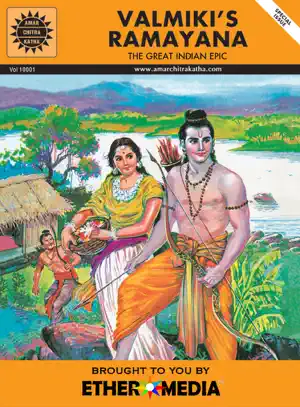
Valmiki's Ramayana
15,00 kr
Köp på Amazon Visa i Apple BooksHellre på papper? Alla format hos Amazon →
Pris i Apple Books. Priset på Amazon kan skilja sig.
- Utgiven
- Genrer
- SerietidningarSerier och grafiska romanerGrafiska romanerKonst och underhållningKonst och arkitekturYrkesrelaterat och teknikUtbildning
- Sexscener
- Inga eller bakom stängd dörr
- Målgrupp
- Unga vuxna
- Tempo
- Lagom
- Tropes
- Episkt äventyrMytologi
Sexscener, målgrupp och tempo är uppskattade utifrån förlagets beskrivning.
På topplistorna
| Placering | Bästa | Dagar | |
|---|---|---|---|
| Serietidningar | #3 | #4 | 9 |
För författare: sätt den här badgen på din webbplats

Kopiera den här koden till din webbplats eller blogg:
Beskrivning
VALMIKI'S RAMAYANA
The great Indian epic
Valmiki's Ramayana is believed to be the first poetic work written in Sanskrit; it is, therefore, referred to as the Adikavya. It is said that Brahma assured Valmiki that "as long as the mountains stand and the rivers flow, so long shall the Ramayana be read by men."
In the Puranas, Rama is described as an avatar of Vishnu, but Valmiki does not refer to him as God. The few verses which do so are considered interpolations.
The Ramayana consists of 24,000 verses. There are six sections - The Bala Kanda, the Ayodhya Kanda, the Aranya Kanda, the Kishkindha Kanda, the Sundara Kanda and the Yuddha Kanda. The seventh section, the Uttara Kanda, is probably an interpolation.
Valmiki's monumental work influenced other great poems on the same theme. Among these are the Hindi, Tamil and Bengali versions of the Ramayana written by Tulsidas in the North; Kamban in the South; and Krittivasa in the East.
The Ramayana has made a deep and abiding impact.