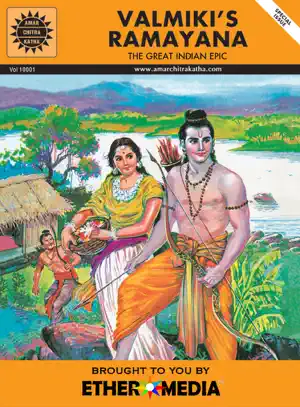
Valmiki's Ramayana
3,99 €
Acheter sur Amazon Voir sur Apple BooksVous le préférez en papier ? Tous les formats sur Amazon →
Prix sur Apple Books. Le prix sur Amazon peut être différent.
Vous lisez beaucoup ? Essayez Kindle+ * · Comparer les abonnements
- Publié
- Genres
- Bandes dessinéesBD et mangasRomans graphiquesArts et spectaclesArt et architectureProfessionnel et techniqueÉducation
- Scènes de sexe
- Aucune ou porte fermée
- Public
- Young adult
- Rythme
- Modéré
- Tropes
- Mythologie
Les scènes de sexe, le public et le rythme sont estimés d’après la description de l’éditeur.
Dans les classements
| Position | Meilleure | Jours | |
|---|---|---|---|
| Bandes dessinées | #8 | #8 | 9 |
Pour les auteurs : affichez ce badge sur votre site

Copiez ce code sur votre site ou votre blog :
Description
VALMIKI'S RAMAYANA
The great Indian epic
Valmiki's Ramayana is believed to be the first poetic work written in Sanskrit; it is, therefore, referred to as the Adikavya. It is said that Brahma assured Valmiki that "as long as the mountains stand and the rivers flow, so long shall the Ramayana be read by men."
In the Puranas, Rama is described as an avatar of Vishnu, but Valmiki does not refer to him as God. The few verses which do so are considered interpolations.
The Ramayana consists of 24,000 verses. There are six sections - The Bala Kanda, the Ayodhya Kanda, the Aranya Kanda, the Kishkindha Kanda, the Sundara Kanda and the Yuddha Kanda. The seventh section, the Uttara Kanda, is probably an interpolation.
Valmiki's monumental work influenced other great poems on the same theme. Among these are the Hindi, Tamil and Bengali versions of the Ramayana written by Tulsidas in the North; Kamban in the South; and Krittivasa in the East.
The Ramayana has made a deep and abiding impact.