Rabindranath Tagore
15,00 kr
Köp på Amazon Visa i Apple BooksHellre på papper? Alla format hos Amazon →
Pris i Apple Books. Priset på Amazon kan skilja sig.
- Utgiven
På topplistorna
| Placering | Bästa | Dagar | |
|---|---|---|---|
| Serietidningar | #14 | #14 | 7 |
För författare: sätt den här badgen på din webbplats

Kopiera den här koden till din webbplats eller blogg:
Beskrivning
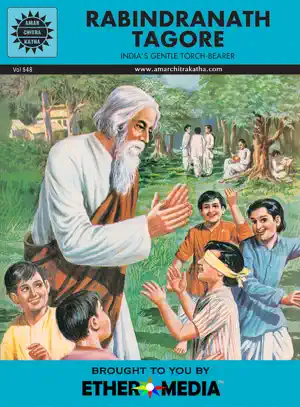
RABINDRANATH TAGORE
India's gentle torch bearer
Rabindranath Tagore played a significant role in bringing about a new awakening in India in the latter half of the nineteenth century. His life and creative work provided the then Indian society with a purpose, direction and a programme. The impact of his personality transcended his native Bengal and came to be felt not only in other parts of India but also abroad.
Tagore was a genius with a many-sided personality. He was a poet, novelist, dramatist, musician, short-story writer, teacher, painter, educationist, philosopher and humanist. Shri Khanolkar, his biographer, describes his life as 'a long dream of colour and music, of beauty and heavenly genius, such as this world has never known before'. Perhaps no other contemporary Indian had such diverse interests as Tagore had. He was a seeker. He wanted to understand himself; and that he could only do by expressing himself. As the experiences and emotions differed, the media also varied. That is how we have Tagore the poet, Tagore the composer, Tagore the painter and so on. Although a staunch nationalist, Tagore was a champion of internationalism, touring various countries and pleading for 'one world'.
He has the unique distinction of being the only poet to have two of his songs - Jana Gana Mana and Amar Sonar Bangla - adopted as the national anthem of two countries, India and Bangladesh respectively. Shanti-Niketan stands to this day as a living monument to the Gurudev. He composed over 4,000 songs. His compositions have come to be known as Rabindra Sangeet.