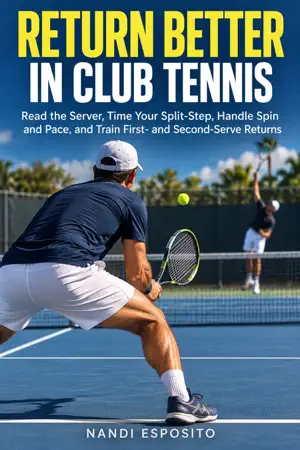
Return Better in Club Tennis
$9.99
Buy on Amazon View on Apple BooksPrefer it in print? See every format on Amazon →
Price on Apple Books. Amazon’s price may differ.
- Published
Description
Return Better in Club Tennis
Read the Server, Time Your Split-Step, Handle Spin and Pace, and Train First- and Second-Serve Returns
Your opponent serves. You decide what happens next.
Most club players practise their forehands and serves until the balls run out, then treat the return as something that will somehow improve by itself. It rarely does. Miss a return and the point is over. Float one back short and you may have handed the server an easy first strike.
Return Better in Club Tennis gives recreational players a practical plan for the shot that starts every receiving point. It explains how to read the server's preparation, time your tennis split-step, choose between a compact block and a controlled drive, and send the return to a target that makes the next ball playable.
Inside, you'll learn to:
- Read cues from a server's toss, racket and contact without gambling on every delivery.
- Handle a fast first serve return with a shorter, calmer swing and sensible depth.
- Turn a slower second serve return into a chance to take control, without trying to paint every line.
- Adjust against flat, slice and kick serves, including higher bounces and wide deliveries.
- Choose return placement for singles and a doubles return of serve that accounts for the net player.
- Use club tennis return drills, checklists and practice records to identify what is actually improving.
- Build more reliable timing, contact and recovery over a six-week progression.
The book moves from fundamentals to match situations, with specific drills, troubleshooting sections, illustrative player scenarios and references to the rules of tennis. It explains when the humble block is the clever answer and when an attack is worth the risk. Sometimes the smartest return is simply one that makes the server play tennis.
Whether you're preparing for league matches, learning to return kick serves or looking for a more dependable answer to a big first serve, this is a court-side reference you can put to use at your next practice.
Make the return a shot you train, rather than a point you hope to survive.
The text of this book was generated using an AI-based tool.