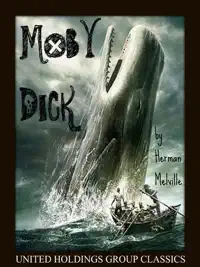
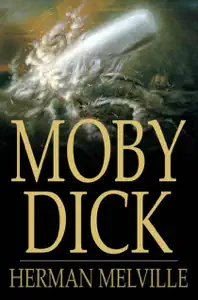
Moby Dick
★★★★★ 4.0 (355 ratings)
Free
Free on Apple Books Buy on AmazonPrefer it in print? See every format on Amazon →
Price on Apple Books. Amazon’s price may differ.
- Published
- On screen
- 🎬 TV series · 2011 · Moby Dick
🎬 Film · 2011 · Age of the Dragons
🎬 Film · 2010 · Moby Dick
In other languages: Moby Dick · Japanese Moby Dick · Spanish Moby Dick · Portuguese Moby Dick · German Moby Dick · Italian Moby Dick · Dutch Moby Dick · French Moby Dick · Swedish
Description
Moby-Dick; or, The Whale is a novel by Herman Melville, first published in 1851. It is considered to be one of the Great American Novels. The story tells the adventures of wandering sailor Ishmael, and his voyage on the whaleship Pequod, commanded by Captain Ahab. Ishmael soon learns that Ahab has one purpose on this voyage: to seek out Moby Dick, a ferocious, enigmatic white sperm whale. In a previous encounter, the whale destroyed Ahab's boat and bit off his leg, which now drives Ahab to take revenge.
In Moby-Dick, Melville employs stylized language, symbolism, and metaphor to explore numerous complex themes. Through the journey of the main characters, the concepts of class and social status, good and evil, and the existence of God are all examined, as the main characters speculate upon their personal beliefs and their places in the universe. The narrator's reflections, along with his descriptions of a sailor's life aboard a whaling ship, are woven into the narrative along with Shakespearean literary devices, such as stage directions, extended soliloquies, and asides. The book portrays destructive obsession and monomania, as well as the assumption of anthropomorphism.
In Moby-Dick, Melville employs stylized language, symbolism, and metaphor to explore numerous complex themes. Through the journey of the main characters, the concepts of class and social status, good and evil, and the existence of God are all examined, as the main characters speculate upon their personal beliefs and their places in the universe. The narrator's reflections, along with his descriptions of a sailor's life aboard a whaling ship, are woven into the narrative along with Shakespearean literary devices, such as stage directions, extended soliloquies, and asides. The book portrays destructive obsession and monomania, as well as the assumption of anthropomorphism.