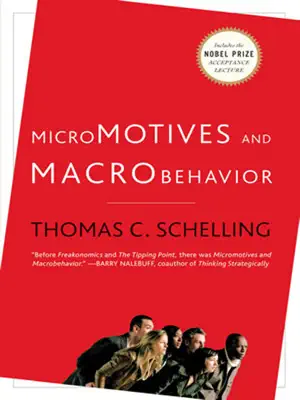
Micromotives and Macrobehavior
£7.99
Buy on Amazon View on Apple BooksPrefer it in print? See every format on Amazon →
Price on Apple Books. Amazon’s price may differ.
- Published
On the charts
| Position | Best | Days | |
|---|---|---|---|
| Economics | #4 | #4 | 1 |
| Business & Personal Finance | #14 | #14 | 1 |
For authors: put this badge on your website

Copy this code into your website or blog:
Description
Before Freakonomics and The Tipping Point there was this classic by the 2005 Nobel Laureate in Economics.
"Schelling here offers an early analysis of 'tipping' in social situations involving a large number of individuals." —official citation for the 2005 Nobel Prize
Micromotives and Macrobehavior was originally published over twenty-five years ago, yet the stories it tells feel just as fresh today. And the subject of these stories—how small and seemingly meaningless decisions and actions by individuals often lead to significant unintended consequences for a large group—is more important than ever. In one famous example, Thomas C. Schelling shows that a slight-but-not-malicious preference to have neighbors of the same race eventually leads to completely segregated populations.
The updated edition of this landmark book contains a new preface and the author's Nobel Prize acceptance speech.


