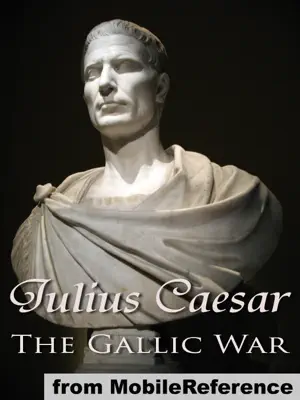
The Gallic War
Julius Caesar, W. A. McDevitte (Translator), W. S Bohn (Translator)
£0.49
Buy on Amazon View on Apple BooksPrefer it in print? See every format on Amazon →
Price on Apple Books. Amazon’s price may differ.
- Published
Description
Translation based on W. A. McDevitte and W. S. Bohn, 1869 The Gallic Wars were a series of military campaigns waged by the Roman
proconsul Julius Caesar against several Gallic tribes, lasting from 58 BC to 51
BC. The Romans would also raid Britannia and Germania, but these expeditions
never developed into full-scale invasions. The Gallic Wars culminated in the
decisive Battle of Alesia in 52 BC, in which a complete Roman victory resulted
in the expansion of the Roman Republic over the whole of Gaul. The wars paved
the way for Caesar's subsequent becoming the sole ruler of the Roman
Republic.
Although Caesar portrayed this invasion as being a defensive pre-emptive action, most historians agree that the wars were fought primarily to boost Caesar's political career and to pay off his massive debts. Still, one can not lightly discard the military importance of Gaul for the Romans themselves, who had been attacked several times by native tribes both indigenous to Gaul and further to the north. Conquering Gaul allowed Rome to secure the natural border of the river Rhine.
This military campaign is painstakingly described by Julius Caesar himself in his book Commentarii de Bello Gallico, which still is the most important historical source. This book is also a masterwork of political propaganda, as Caesar was keenly interested in manipulating his readers in Rome.
— Excerpted from Wikipedia, the free encyclopedia.