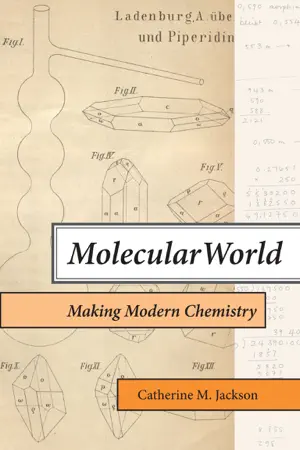
Molecular World
499,00 kr
Köp på Amazon Visa i Apple BooksHellre på papper? Alla format hos Amazon →
Pris i Apple Books. Priset på Amazon kan skilja sig.
- Utgiven
På topplistorna
| Placering | Bästa | Dagar | |
|---|---|---|---|
| Vetenskapshistoria | #75 | #75 | 6 |
För författare: sätt den här badgen på din webbplats

Kopiera den här koden till din webbplats eller blogg:
Beskrivning
A compelling and innovative account that reshapes our view of nineteenth-century chemistry, explaining a critical period in chemistry’s quest to understand and manipulate organic nature.
According to existing histories, theory drove chemistry’s remarkable nineteenth-century development. In Molecular World, Catherine M. Jackson shows instead how novel experimental approaches combined with what she calls “laboratory reasoning” enabled chemists to bridge wet chemistry and abstract concepts and, in so doing, create the molecular world. Jackson introduces a series of practice-based breakthroughs that include chemistry’s move into lampworked glassware, the field’s turn to synthesis and subsequent struggles to characterize and differentiate the products of synthesis, and the gradual development of institutional chemical laboratories, an advance accelerated by synthesis and the dangers it introduced.
Jackson’s historical reassessment emerges from the investigation of alkaloids by German chemists Justus Liebig, August Wilhelm Hofmann, and Albert Ladenburg. Stymied in his own research, Liebig steered his student Hofmann into pioneering synthesis as a new investigative method. Hofmann’s practice-based laboratory reasoning produced a major theoretical advance, but he failed to make alkaloids. That landmark fell to Ladenburg, who turned to cutting-edge theory only after his successful synthesis.
In telling the story of these scientists and their peers, Jackson reveals organic synthesis as the ground chemists stood upon to forge a new relationship between experiment and theory—with far-reaching consequences for chemistry as a discipline.