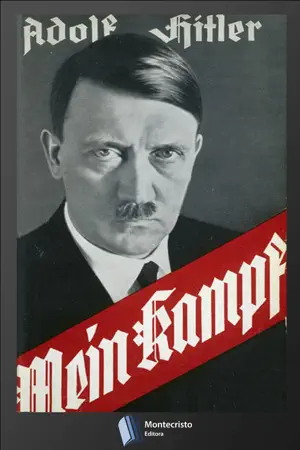
Mein Kampf
25,00 kr
Köp på Amazon Visa i Apple BooksHellre på papper? Alla format hos Amazon →
Pris i Apple Books. Priset på Amazon kan skilja sig.
- Utgiven
På andra språk: Mein Kampf · Engelska Mi Lucha (Mein Kampf) · Spanska La mia battaglia · Italienska Mein Kampf · Nederländska Mein Kampf French Version · Franska
På topplistorna
| Placering | Bästa | Dagar | |
|---|---|---|---|
| Politik och aktuella händelser | #11 ▼3 | #11 | 6 |
Placering de senaste 30 dagarna · #1–#14 · Placering 11
För författare: sätt den här badgen på din webbplats
Kopiera den här koden till din webbplats eller blogg:
Beskrivning
The angry ranting of an obscure, small-party politician, the first volume of Mein Kampf was virtually ignored when it was originally published in 1925. Likewise the second volume, which appeared in 1926. The book details Hitler's childhood, the "betrayal" of Germany in World War I, the desire for revenge against France, the need for lebensraum for the German people, and the means by which the National Socialist party can gain power. It also includes Hitler's racist agenda and his glorification of the "Aryan" race. The few outside the Nazi party who read it dismissed it as nonsense, not believing that anyone could--or would--carry out its radical, terrorist programs. As Hitler and the Nazis gained power, first party members and then the general public were pressured to buy the book. By the time Hitler became chancellor of the Third Reich in 1933, the book stood atop the German bestseller lists. Had the book been taken seriously when it was first published, perhaps the 20th century would have been very different. Beyond the anger, hatred, bigotry, and self-aggrandizing, Mein Kampf is saddled with tortured prose, meandering narrative, and tangled metaphors (one person was described as "a thorn in the eyes of venal officials"). That said, it is an incredibly important book. It is foolish to think that the Holocaust could not happen again, especially if World War II and its horrors are forgotten. As an Amazon.com reader has pointed out, "If you want to learn about why the Holocaust happened, you can't avoid reading the words of the man who was most responsible for it happening." Mein Kampf, therefore, must be read as a reminder that evil can all too easily grow.


