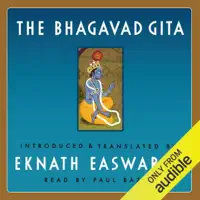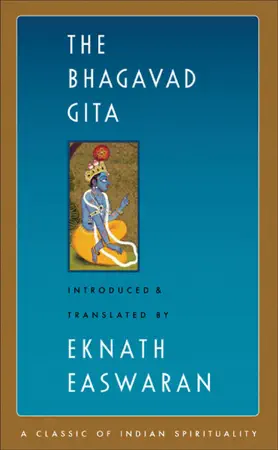
The Bhagavad Gita
€ 5,99
Kopen bij Amazon Bekijk in Apple BooksLiever op papier? Alle uitvoeringen bij Amazon →
Prijs in Apple Books. Bij Amazon kan die afwijken.
- Ook als luisterboek
- The Bhagavad Gita (Unabridged)
- Verschenen
In andere talen: Die Bhagavad Gita · Engels Die Bhagavad Gita · Duits Die Bhagavad Gita · Spaans Die Bhagavad Gita · Italiaans Die Bhagavad Gita · Zweeds
In de lijsten
| Positie | Beste | Dagen | |
|---|---|---|---|
| Hindoeïsme | #1 | #3 | 10 |
| Religie en spiritualiteit | #54 ▼2 | #43 | 9 |
Positie in de afgelopen 30 dagen · #1–#57 · Positie 54
Voor auteurs: zet deze badge op je website

Kopieer deze code naar je website of blog:
Beschrijving
The Bhagavad Gita is the best known of all the Indian scriptures, and Eknath Easwaran’s best-selling translation is reliable, readable, and profound.
Easwaran's 55-page introduction places the Bhagavad Gita in its historical setting and brings out the universality and timelessness of its teachings. Chapter introductions give clear explanations of key concepts, and notes and a glossary explain Sanskrit terms.
Easwaran grew up in the Hindu tradition in India and learned Sanskrit from a young age. He was a professor of English literature before coming to the West on a Fulbright scholarship. A gifted teacher, he is recognized as an authority on the Indian classics and world mysticism.
“No one in modern times is more qualified – no, make that ‘as qualified’ – to translate the epochal Classics of Indian Spirituality than Eknath Easwaran. And the reason is clear. It is impossible to get to the heart of those classics unless you live them, and he did live them. My admiration of the man and his works is boundless.” – Huston Smith, author of The World’s Religions.
The Bhagavad Gita opens, dramatically, on a battlefield, as the warrior Arjuna turns in anguish to his spiritual guide, Sri Krishna, for answers to the fundamental questions of life. Yet the Gita is not what it seems – it’s not a dialogue between two mythical figures at the dawn of Indian history. “The battlefield is a perfect backdrop, but the Gita’s subject is the war within, the struggle for self-mastery that every human being must wage if he or she is to emerge from life victorious.”
Arjuna’s struggle in the Bhagavad Gita is acutely modern. He has lost his way on the battlefield of life and turns to find the path again by asking direct, uncompromising questions of his spiritual guide, Sri Krishna, the Lord himself. Krishna replies in 700 verses of sublime instruction on living and dying, loving and working, and the nature of the soul.
Easwaran shows the Gita’s relevance to us today as we strive, like Arjuna, to do what is right.