Zum Inhalt
eBook Charts
DE
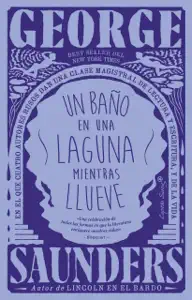
A Swim in a Pond in the Rain

Beschreibung

NEW YORK TIMES BESTSELLER • From the Booker Prize–winning author of Lincoln in the Bardo and Tenth of December comes a literary master class on what makes great stories work and what they can tell us about ourselves—and our world today.

LONGLISTED FOR THE PEN/DIAMONSTEIN-SPIELVOGEL AWARD • ONE OF THE BEST BOOKS OF THE YEAR: The Washington Post, NPR, Time, San Francisco Chronicle, Esquire, Milwaukee Journal Sentinel, Town & Country, The Rumpus, Electric Lit, Thrillist, BookPage

“[A] worship song to writers and readers.”—Oprah Daily, "Best Nonfiction Books of the Past Two Decades"


For the last twenty years, George Saunders has been teaching a class on the Russian short story to his MFA students at Syracuse University. In A Swim in a Pond in the Rain, he shares a version of that class with us, offering some of what he and his students have discovered together over the years. Paired with iconic short stories by Chekhov, Turgenev, Tolstoy, and Gogol, the seven essays in this book are intended for anyone interested in how fiction works and why it’s more relevant than ever in these turbulent times.

In his introduction, Saunders writes, “We’re going to enter seven fastidiously constructed scale models of the world, made for a specific purpose that our time maybe doesn’t fully endorse but that these writers accepted implicitly as the aim of art—namely, to ask the big questions, questions like, How are we supposed to be living down here? What were we put here to accomplish? What should we value? What is truth, anyway, and how might we recognize it?” He approaches the stories technically yet accessibly, and through them explains how narrative functions; why we stay immersed in a story and why we resist it; and the bedrock virtues a writer must foster. The process of writing, Saunders reminds us, is a technical craft, but also a way of training oneself to see the world with new openness and curiosity.

A Swim in a Pond in the Rain is a deep exploration not just of how great writing works but of how the mind itself works while reading, and of how the reading and writing of stories make genuine connection possible.

Das könnte dir auch gefallen

Les mauvaises pensées du «Grand Meaulnes»Alain Buisine8,49 €GeheimnisseBob Woodward, Sylvia Bieker, Gisela Fichtl, Thomas Gunkel, Elisabeth Liebl & Anke Wagner-Wolff29,99 €BuddenbrooksThomas Mann0,49 €★ 5,0„Der Vater – Eine Abrechnung“ von Niklas Frank. Eine Sonderform unter den biografischen Romanen?Matthias Andrzejewski15,99 €200 Meisterwerke der Literaturgeschichte (Kommentiert)Franz Kafka, Victor Hugo, Fjodor Michailowitsch Dostojewski, Lord Byron, Giacomo Leopardi, Marcel Proust, Henrik Ibsen, Percy Bysshe Shelley, Charles Dickens, Jane Austen, Mary Shelley, Emily Brontë, Charlotte Brontë, Anne Brontë, William Makepeace Thackeray, Bram Stoker, Henry Fielding, George Eliot, William Shakespeare, D. H. Lawrence, Walt Whitman, Herman Melville, Thomas Wolfe, Virginia Woolf, Joseph Conrad, Sinclair Lewis, Lewis Carrol, Edgar Allan Poe, Edward Bulwer-Lytton, Oscar Wilde, H.G. Wells, Daniel Defoe, James Fenimore Cooper, Lew Wallace, Jonathan Swift, Mark Twain, Walter Scott, Nathaniel Hawthorne, Harriet Beecher Stowe, Laurence Sterne, Frances Hodgson Burnett, Arthur Conan Doyle, Wilkie Collins, Edgar Wallace, Robert Louis Stevenson, Jack London, Henry David Thoreau, John Galsworthy, F. Scott Fitzgerald, Rudyard Kipling, G. K. Chesterton, Washington Irvin, O. Henry, Ambrose Bierce, Alexander Sergejewitsch Puschkin, Michail Lermontow, Iwan Sergejewitsch Turgenew, Leo Tolstoi, Nikolai Gogol, Iwan Gontscharow, Nikolai Leskow, Anton Pawlowitsch Tschechow, Maxim Gorki, François Rabelais, Jean de La Fontaine, Blaise Pascal, Pierre Corneille, Molière, Jean Baptiste Racine, Charles Perrault, Voltaire, Denis Diderot, Jean-Jacques Rousseau, Pierre Ambroise Choderlos de Laclos, Antoine-François Prevost, Marquis de Sade, François René Chateaubriand, Stendhal, Honoré de Balzac, Alexandre Dumas, Alphonse de Lamartine, George Sand, Gustave Flaubert, Émile Zola, Guy de Maupassant, Alphonse Daudet, Jules Verne, Joris-Karl Huysmans, Prosper Mérimée, Charles Baudelaire, Stéphane Mallarmé, Arthur Rimbaud, André Gide, Arthur Schopenhauer, Heinrich Heine, Friedrich Schiller, Johann Wolfgang von Goethe, Gebrüder Grimm, Gottfried Von Straßburg, Wolfram von Eschenbach, E. T. A. Hoffmann, Annette von Droste-Hülshoff, Heinrich von Kleist, Friedrich Hölderlin, Theodor Fontane, Gustav Freytag, Gottfried Keller, Theodor Storm, Stefan Zweig, Joseph von Eichendorff, Klaus Mann, Rainer Maria Rilke, Johanna Spyri, Joseph Roth, Karl May, Robert Musil, Heinrich Mann, Sigmund Freud, Friedrich Nietzsche, Dante Alighieri, Giovanni Boccaccio, Giacomo Casanova, Luigi Pirandello, Giosuè Carducci, Gabriele D'Annunzio, Niccolò Machiavelli, Miguel Cervantes de Saavedra, Pedro Calderón de la Barca, Vicente Blasco Ibáñez, Knut Hamsun, Homer, Äsop, Herodot, Thukydides, Xenophon, Platon, Aristoteles, Sophokles, Euripides, Aristophanes, LaoTse, Konfuzius, Siddhartha Gautama Buddha, Titus Livius, Tacitus, Cicero, Vergil, Ovid, Lukian, Petronius, Apuleius, Longos von Lesbos, Mark Aurel, Aurelius Augustinus & e-artnow2,99 €Dictionary of Fine DistinctionsEli Burnstein8,49 €Argumentieren in der Literaturwissenschaft. Eine EinführungThomas Petraschka & Stefan Descher7,99 €Joke FarmingElliott Kalan4,49 €OdysseeHomer1,99 €LiteraturwissenschaftSabina Becker, Christine Hummel & Gabriele Sander16,99 €"Der Recke im Tigerfell". Das georgische Nationalepos und das NibelungenliedRainer Schoeffl15,99 €Einladung, Dante zu lesenKurt Flasch12,99 €